
Learn more about Canadian mortgage rates, rules and the latest news – read on!
Latest News


Making sense of the markets this week: September 24, 2023 + MORE Sep 23rd
Allan Small, Senior Investment Advisor at the Allan Small Financial Group with iA Private Wealth, shares financial headlines and offers context for Canadian investors.
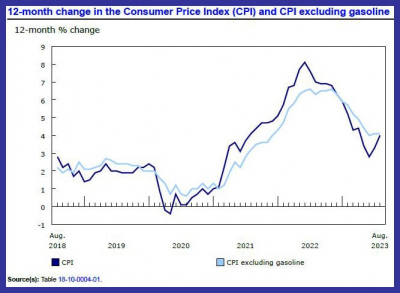
No surprise: Canada’s inflation rate ticked up in August
Canada’s annual inflation rate jumped to 4% in August, up from 3..... More »
Latest in Mortgage News – Industry Announcements Nov 26th
There’s been a number of big mortgage industry announcements in recent weeks, ranging from reverse mortgage offerings to a new broker tech partnership and a key appointment at one of the country’s top brokerages. Here’s a look at each… Equitable Raises Allowable Equity Takeou.... More »
Real estate may not be sexy, but… Jan 26th
Rental properties are a secure long-term investment. Note the emphasis on “long-term”.
Check out any seven-year period over the past 50 years (anyone who has read this news site knows that I always recommend buying and holding for at least seven years). Property values have almost alway.... More »
Packing Less Punch: Millennials’ Home Purchasing Power Drops by $40K due to New Stress Test Rules + MORE May 6th
Millennials looking to purchase new property across Canada this year are going to have to settle for less. The average peak millennial’s purchasing power in Canada is 16.5 per cent lower than it was at this time last year, meaning they qualify for a mortgage of about $40,000 less than before.
The.... More »
Lender Calls – Q3 Roundup + MORE Dec 21st
Canada’s biggest non-bank lenders have all reported third-quarter earnings. In their earnings calls they outlined how they’re coping with Ottawa’s recent changes to the mortgage qualification and insurance rules. Per usual, we’ve combed through their transcripts in order to se.... More »
Dire Debt Warnings from the Bank of Canada: Financial System Review
– ratesupermarket.ca

For more than a decade now, Canadian homeowners have enjoyed some of the lowest mortgage interest rates in the country’s history. Today, you can find variable rate mortgages as low as 2.05 per cent. But the downside to cheap money is that many Canadians have built up significant debt loads, and many could face devastating consequences if and when interest rates do start to rise.
In the Bank of Canada’s December 2015 Financial Systems Review titled Indebted Households and Potential Vulnerabilities for the Canadian Financial System, the central bank has found that the number of highly indebted Canadian households – those with a debt-to-income ratio of higher than 350 per cent – has doubled from 4 to 8 per cent since the financial crisis, with the highest debt carriers residing in Alberta, British Columbia, and Ontario. The national debt-to-income ratio average is 164.4 per cent.
Real estate assets count for 90 per cent of debt for this group – leaving them especially vulnerable to the possibility of rising interest rates or a house price correction…
For over a decade, the articles, commentary and analysis focusing on the Toronto and Vancouver housing markets have addressed high levels of mortgage debt, speculative investors, foreign buyers and the inevitable unfolding of the markets when interest rates inevitably rise. It has been hypothesized that the unraveling of these major housing markets will inflict pain on the entire Canadian economy.
Should we keep waiting another 10 years for this scenario to play out, or should we come up with new explanations for what is happening in the Toronto and Vancouver housing markets?
Perhaps the biggest problem is a comparison problem. When you go out shopping for anything, you compare the price of the item you want to the price you paid before, or else you compare the price to a similar item whose price you know.
You check out a couple of different stores in the mall, perhaps you go online or head south of the border to an outlet store — you’ll get a pretty good idea if something is a deal or if it’s is overpriced…
What Happens To Debt When You Get Married?
– ratesupermarket.ca

Many couples are getting married with a significant amount of debt. One or both partners might have student loans, credit card debt, a line of credit, an auto loan, or a mortgage. In 2014, Harris/Decima conducted a poll that showed two in five Canadian newlyweds enter their marriages with debt and owe, on average, $21,500.
Also read: The Cost of Love in Canada: $50,339.21>
So, what happens to this debt when you tie the knot or become common law partners? And what happens to debt that you accumulate during your marriage?
This article explores how debt can affect the finances of married or common law couples.
Pre-Existing Debt
The good news is that you won’t be held liable for any pre-existing debt that your partner brings with them to the marriage or partnership. Unless you co-signed for the loan or credit card, pre-existing debt is seen as entirely your partner’s responsibility.
Student Loan Debt
Student loan debt remains the responsibility of the borrower even after you’re married, but marriage or common law status might affect the repayment of your student loans and your ability to take out new student loans…
'Big Short,' Big Hooey
– online.wsj.com
 Forget mortgages. A change of accounting rules could have avoided the crisis.
U.S. hikes rates, Canada not likely to follow suit
– moneysense.ca
TORONTO – The U.S. Federal Reserve’s interest rate hike could exert downward pressure on the loonie in the midst of its steady drop in recent months as global oil prices have plunged.
The American central bank says it’s lifting its key rate by a quarter-point to a range of 0.25 per cent to 0.5 per cent, ending a seven-year period of near-zero borrowing rates.
Scott Guitard, a portfolio manager at Fiduciary Trust Canada, said climbing American interest rates will likely mean the opposite for the Canadian dollar.
He also predicts Canada’s central bank will stick with its decision to hold steady on its key lending rate even if the loonie falls further because of enduring low oil prices. The price of oil fell below $36 a barrel in mid-day trading.
Mortgage rates are rising »
Canada’s central bank has cut its own key lending rate twice this year.
Prime Minister Justin Trudeau, speaking in advance of the announcement, said it was a good sign that the American economy was seeing a resurgence, but promised to examine the challenges that a lower dollar poses for the Canadian economy…
The American central bank says it’s lifting its key rate by a quarter-point to a range of 0.25 per cent to 0.5 per cent, ending a seven-year period of near-zero borrowing rates.
Scott Guitard, a portfolio manager at Fiduciary Trust Canada, said climbing American interest rates will likely mean the opposite for the Canadian dollar.
He also predicts Canada’s central bank will stick with its decision to hold steady on its key lending rate even if the loonie falls further because of enduring low oil prices. The price of oil fell below $36 a barrel in mid-day trading.
Mortgage rates are rising »
Canada’s central bank has cut its own key lending rate twice this year.
Prime Minister Justin Trudeau, speaking in advance of the announcement, said it was a good sign that the American economy was seeing a resurgence, but promised to examine the challenges that a lower dollar poses for the Canadian economy…

