

Canadians Ill-Prepared for a Rate Hike; Unprecedented Debt Imminent + MORE Jun 29th
Canada Mortgage Rules Could Hurt More Than They Help: Experts + MORE Apr 12th
No signs of distress among borrowers yet, First National says + MORE Nov 10th
Bank CEOs see mortgage risk easing as attention turns to political uncertainty + MORE Jan 8th

How to Improve Your Credit Score – Student Edition Aug 29th
Is Your Debt Above Average?
– ratesupermarket.ca
Household debt levels are a hot topic this week, as new numbers reveal they are higher than ever across the nation – a key concern for our central bank, and the fuel behind Canada’s too-hot-to-touch housing markets. And it’s not just mortgages – a recent study finds credit card balances are on the rise, with the average Canadian owing more than $3k on their plastic. Read on for the full story.
Canadian Debt-to-Income Ratio Is Now 165%
Household debt levels are rising across the nation: the average Canadian now owes $1.65 for every dollar they earn, according to Statistics Canada, collectively owing a whopping $1.923 trillion – and $1.262 trillion of that is from mortgages. What does this mean for Canada’s recovering economy – and are you at risk as a consumer?
Read Penelope’s Blog | Canadian Debt-to-Income Ratio Is Now165%
National Credit Card Debt Hits 3-Year High
Is your credit card balance below the national average? A recent TransUnion report finds the average Canadian has racked up $3,610 on their plastic…
How to avoid the underwater mortgage
– moneysense.ca
 (John Lund/Getty Images)
Q: I’ve read a lot about the possibility of first time home buyers ending up with an underwater mortgage? I’m not sure what this is, but it doesn’t sound good. Can you explain what an underwater mortgage is and how to avoid it?
— Trying to be responsible, Calgary, Alta.
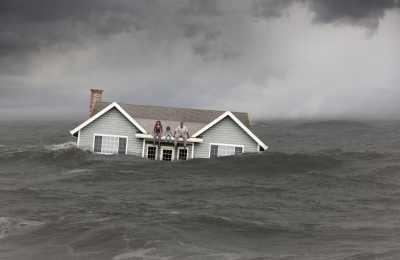
Answer from Robert McLister, mortgage planner with Ratespy: No homeowner wants an underwater mortgage. It means you have negative equity—i.e., you owe your lender more than your home is worth.
If you’re making a small down payment, it’s easy to become submerged. Imagine you’re buying a $400,000 home with only 5% down, for instance (that works out to $20,000). The day you close that mortgage you’ll owe $393,680 including mandatory default insurance fees. That’s a whopping 98.4% of the purchase price.
Now imagine unemployment soars and incomes drop or people just stop buying as many houses, which sends the market into a 20% correction. Suddenly you owe about $390,000 on a property worth only $320,000…
Mortgage Career: Equitable Bank
– canadianmortgagetrends.com
Mortgage Career: ICICI Bank Canada
– canadianmortgagetrends.com

