
Learn more about Canadian mortgage rates, rules and the latest news – read on!
Latest News


How to keep your home after separation—even if you don’t qualify alone + MORE Apr 18th
Separation and divorce are hard enough without throwing mortgage stress into the mix. One of the most emotional questions we hear is, 'I want to keep the house, but I don’t make enough on my own to qualify—what can I do?'.... More »
Incorporate Balance Transfer Offers into Your Arsenal Oct 20th
As mortgage professionals, we are sometimes asked to solve problems slightly outside the scope of our mandate. Naturally, we must take care not to position ourselves as tax experts, accountants or lawyers..... More »
Ask the Expert: Steve Garganis – How Trump’s tariffs will affect your Canadian mortgage + MORE Feb 1st
I will start with a quote from Trump’s book, The Art of the Deal
“I aim very high and then I just keep pushing and pushing and pushing to get what I’m after. Sometimes I settle for less than I thought but I still end up with what I want.“
In the summer of 2016, ahead of .... More »
Sagen sees earnings dip, offset by stronger mortgage insurance growth + MORE Nov 9th
Mortgage insurer Sagen’s premiums climbed 32% from last year as lower rates fuel housing demand, but softer investment income pulled net earnings down to $119 million..... More »
Canadians opting for shorter mortgage terms as they hope for declining interest rates + MORE Jun 15th
Canadian housing mortgage rates are all over the map. Don't get trapped in an unnecessarily costly mortgage agreement.
You Don’t Need a Big Bank to Get a Mortgage - canadamortgagenews.caIt’s tough to get a mortgage these days. New and existing clients have been calling non-stop letting me.... More »
It Now Costs 109% of Income to Own a House in Vancouver
– ratesupermarket.ca
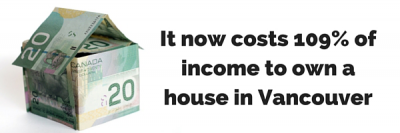
It’s official: for most Canadians, it’s impossible to afford a house in Vancouver. RBC recently released a report where they calculated that owning a detached house in the city exceeds the average Canadian’s pre-tax earnings, and Toronto isn’t far behind.
Million-Dollar Bungalows
In February 2016, the average price of a detached house in Vancouver hit $1.3 million, a 27 per cent increase over the previous year. Based on the median income of households in the Vancouver area, the bank calculates that it would take 109 per cent of pre-tax income just to cover basic costs to own a house in Vancouver – mortgage payments, property tax, and utility bills. That’s not a typo – all their money, plus 9 per cent! And it doesn’t include money for anything else, like food, clothes, or entertainment.
In order to qualify for a mortgage on a detached house in the city, a family would need to earn a combined $215,000.
Which leaves condos. “Purchasing a condo is the only realistic option for most first-time buyers – although this too has become slightly less affordable in the last two quarters,” says RBC…
MCAP’s Fusion – Mortgage of the Year
– canadianmortgagetrends.com
True innovation has become a rarity among mortgage lenders. The mortgage crisis and subsequent government policies (which restricted mortgage liquidity) have made it harder to fund unique value-added products. But every now and then you see a product that creates new competition and gives consumers an important new choice. For eight years now, CMT has recognized the new mortgage that most positively impacted the market in the preceding year. In 2015, MCAP met that criteria with its launch of Fusion, a fully readvanceable mortgage with a fixed or variable mortgage linked to a line of credit. Borrowers get easy funds access and READ MORE
Talking Points: Of carbon lows and tennis woes
– macleans.ca
 (Bill Ingalls/NASA/Getty Images)
Need an answer for that? Trying to look like the smartest person at the dinner party? Our Talking Points have you covered. Read our short takes on some of the big stories from the week that was:
Peak carbon? China’s emissions may already be falling.
China’s carbon emissions may have peaked as early as 2014, according to research from the London School of Economics, well ahead of the 2030 goal set out by its leaders. The world’s largest producer of emissions is in the midst of an economic slowdown; it’s also adopting carbon-reduction policies to clean up air pollution so it could be that the targets it set in the U.S.-China climate agreement were too low. Could they do better? Germany, Austria, Portugal and Luxembourg want to try, and are calling on the EU to toughen its 2030 climate goals. Targets, of course, are merely targets. Still, why not be ambitious?
Canadians make for wonderful, nomadic neighbours.
With a Vancouver “teardown” recently selling for $1 million over asking price, the Canada Mortgage and Housing Corp…

