
How GICs can help you save for your short-term goals + MORE Nov 23rd
RRIF withdrawals: What should seniors with million-dollar portfolios do? Nov 16th

Tax implications of making transfers between registered accounts + MORE Dec 21st

Maxed out your TFSA and RRSP? Here’s where to put cash Jan 24th

Bombardier makes changes at the top, suspends dividend + MORE Feb 12th
When to retire to maximize your money
– moneysense.ca
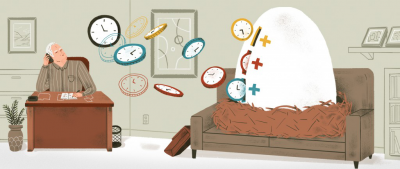 Illustration by Jeannie Phan
If you reach your mid-60s and feel you may not be able to afford the retirement you want, a simple solution can have a surprisingly large impact: keep working for another three years. “If you fall behind the amount you’d like to have and you’re nearing retirement, your most viable and most powerful tool is to delay your retirement,” says Malcolm Hamilton, a retired actuary and a fellow with the C.D. Howe Institute.
This strategy can dramatically improve your finances on the doorstep to retirement because of three powerful factors. First, you can bulk up your nest egg during what are typically your prime saving years. Second, by delaying drawdowns from your portfolio you can bump up your withdrawal rate when you do retire. And third, by delaying the start of government benefits, those payouts will increase. Later on when you eventually do retire, you’ll have a lot more flexibility in the way you choose to draw the income you need.
While this three-way boost can improve just about anyone’s situation, it’s likely to have the greatest impact if your finances are tight…
5 Stages of Long Term Care You Need to Plan for in Retirement
– rhondasherwood.com

When you think about retirement, how do you picture spending your days? It’s only natural to focus on taking time to rest after many years of hard work. If you are currently in good health, it can be difficult to picture the situation changing. In some cases, the changes to your health will be relatively minor ones. In other situations, you or a loved one will be faced with living with a chronic illness or the sudden trauma of an accident. Since Canadians can now look forward to living longer in retirement than previous generations, all of us need to be aware of the 5 stages of long term care which can have an impact on retirement planning.
What are the 5 Stages of Long Term Care?
1. Independence
This is the stage which we hope will last the longest. You are self-sufficient and able to manage your health concerns, including those associated with chronic illness or disability, on your own without help from family or paid caregivers.
2. Interdependence
At this point, health issues will start to interfere with activities of daily living (bathing, dressing, using the bathroom, etc…
GICs: The problem with playing it safe
– moneysense.ca
 Heather Walker, 59 (Photo by Philip Cheung)
The problem
As a 59-year-old training administrator for a mining company, Heather is a member of her company’s defined contribution pension plan. She’s also mortgage-free. But in 2008 she suffered a 40% loss in her stock portfolio and has since slowly sold off all her high-fee mutual funds, putting her 100% in cash. “I have to pay more attention,” says Heather, who has started managing her own finances. After reading up on investing, she’s ready to rebuild her $200,000 portfolio—split evenly between registered and non-registered investments. She plans to add corporate bonds, but isn’t sure what to do about equities. “I have a low risk tolerance.”
The fix
Vancouver money coach Annie Kvick says losing 40% of your portfolio when you’re five to 10 years from retirement is stressful. But investing her entire portfolio in GICs and bonds is risky because Heather could lose her nest egg to inflation, or even outlive her money entirely…
 Don’t worry about the Boomers in retirement, they’ll be fine. Worry instead about the 40-to-55-year-olds behind them. Things won’t be as good for them.
