
Personal Savings getting you down? There are always smart ways to increase your savings.
Latest News


My three kids chose different educational paths. How do I withdraw RESP funds in a way that’s fair to them and avoids unnecessary taxes? Jul 25th
Q. I have a Registered Education Savings Plan (RESP) for my three children, the youngest of whom is starting university this fall. We have made some withdrawals for the older two kids but the plan is still well-funded. Our middle child has decided to pursue a co-op university program, which is esse.... More »
Best in show: How to find and invest in market leaders + MORE Apr 10th
Canadians approach retirement planning in many different ways, but there’s one thing we can all benefit from: a strategy to save enough to retire comfortably and even generate income after we stop working.
But many of us don’t feel financially ready to stop working. According to a 2022 survey.... More »
What’s more important: your wealth or your legacy? + MORE Nov 12th
Ask MoneySense
My dad is 77 years old and we live together in a house worth $840,000, which we own together. Dad retired at age 70 and commuted his pension so he would have money to leave to me. He has about $580,000 divided between a LIF and a RRIF and his CPP is $17,000 and OAS $9,500. He lives on.... More »
Strategically review your employer savings plans before the end of the year + MORE Nov 1st
Employees should actively investigate their options and invest accordingly..... More »
A guide to the best robo-advisors in Canada for 2022 + MORE Aug 7th
“You had me at low fees!” That was our reaction to the arrival of robo-advisors in Canada, beginning in 2014. Faced with few alternatives to mutual funds and self-directed brokerage accounts, young and middle-income investors embraced the option of having their savings passively managed in a bun.... More »
Low interest rates have ‘done their job’, says Poloz
– macleans.ca
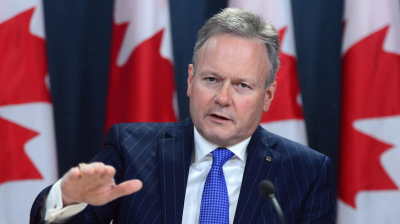 THE CANADIAN PRESS/Sean Kilpatrick
OTTAWA – With the Bank of Canada nearing its next policy decision, governor Stephen Poloz is reiterating his message that his 2015 interest-rate cuts appear to have done their job.
Poloz said in an interview broadcast on business news channel CNBC that the Canadian economy enjoyed “surprisingly” strong growth in the first three months of 2017 and he expected the pace to stay above potential.
The Canadian dollar climbed to 76.44 cents US, up from an average price of 75.83 cents US on Tuesday, as the comments increased speculation about the possibility of an interest rate hike by the Bank of Canada.
If the central bank raises its key interest rate, the big Canadian banks will raise their prime rates, driving up the cost of variable rate mortgages and other loans and lines of credit tied to the benchmark rate.
Poloz credited the two rate cuts introduced by the bank in 2015 for helping the economy counteract the effects of the oil-price slump, which began in late 2014…

Q I lived and worked in the U.S. from 2000-2008 and accumulated some money in a 401K retirement savings plan during this time. I returned to Toronto in 2008, but the 401K was left in the U.S. I’ve decided to move all of the funds from the U.S. account into my RRSP for 2017 and made a full withdrawal of the 401K earlier this year. Will I need to file U.S. taxes with the withdrawal? I have read that a foreigner is not required to file for U.S. tax for this type of withdrawal if this is the only transaction for the year since the 15% withholding tax has already been applied.
My second question is regarding the 10% early withdrawal penalty. I was under the age of 59 when I withdrew the 401K money. However, I don’t see the 10% early withdrawal penalty on the statement. Do I need to include that amount in the U.S. tax filing if I do need to file?
— Adam
A Adam, there is good news and bad news on your situation. The bad news is that yes, you need to file a U.S. tax return and pay both income tax and the 10% penalty for early withdrawal of your U…

