
All about Canadian Savings. Learn the ins and outs and get the latest news.
Latest News

What is an ETF? + MORE Jul 11th
If you want to think about it in really simple terms, an ETF is like a meal kit. How’s that? Well, if you’re someone who enjoys good food, but doesn’t necessarily consider yourself a good cook, you might pick up a meal kit, because it contains all of the pre-selected elements you need to prepa.... More »
The best high-interest savings accounts in Canada for 2025 + MORE Mar 25th
Savings comparison tool
Find the best and most up-to-date savings rates in Canada using the comparison tool below. Plus, use the filters to assess your estimated return based on the size of your balance.
Advertisement
Why trust us
MoneySense is an.... More »
Health-care workers Annie and Ben, 33, can afford a bigger house. But is now the time as they look to grow their family? + MORE May 1st
The couple has a combined annual income of $260,000, a modest mortgage, and is wondering how best to invest their savings..... More »
Can a first-time home buyer have a mortgage co-signer? Sep 18th
If you’re in the market for your first home but need help coming up with the financing, you do have some options, including asking someone to co-sign the mortgage. Involving a third party is probably not what you envisioned for home ownership, but recent interest rate hikes and rising real estate .... More »
How to invest with spousal loans for Canadians—and how to pay it back Sep 5th
During my working life, I transferred non-registered investment shares through a spousal loan to my wife (a stay-at-home mother). At the time of transfer, I declared the capital gain and paid the corresponding tax on the gain on the difference between the FMV (fair market value) and the ACB (adjuste.... More »
Paying yourself first
– moneysense.ca
There is perhaps no single piece of financial advice more frequently repeated than “pay yourself first.” And with good reason. It’s tough to grow savings if you prioritize all your spending needs and wants ahead of putting money away. While some of us fully intend to stash whatever is left at the end of each month, too often that leaves nothing to save.
This tendency to spend everything we earn is something governments understand well.That’s why they make sure they get their share—income taxes—before you even set eyes on your paycheque. Saving with the “pay yourself first” method follows the same principle. And this step-by-step guide shows you how to do it.
Step 1: Zero in on your savings goals
It’s easier to commit to paying yourself first when you know the purpose of your savings. Are you building an emergency fund? Saving for a down payment on a house? Are you hoping to pay for a wedding? Or fund your retirement?
Perhaps you are saving for all of these goals, or different ones…
This tendency to spend everything we earn is something governments understand well.That’s why they make sure they get their share—income taxes—before you even set eyes on your paycheque. Saving with the “pay yourself first” method follows the same principle. And this step-by-step guide shows you how to do it.
Step 1: Zero in on your savings goals
It’s easier to commit to paying yourself first when you know the purpose of your savings. Are you building an emergency fund? Saving for a down payment on a house? Are you hoping to pay for a wedding? Or fund your retirement?
Perhaps you are saving for all of these goals, or different ones…
 Feeling the pressure to put her savings somewhere, Susana wrote to Millennial Money hoping to get advice on what how to manage her finances and if buying a house in the city should be her main goal.
What is CDIC insurance, how it works and what’s covered
– moneysense.ca
Toilet paper isn’t the only thing Canadians were hoarding early in the pandemic. Headlines were buzzing that the Bank of Canada was running short of $50 bills too. Whether you were stuffing cash in your mattress or in the bottom of your sock drawer, the truth is your savings are safer at a financial institution because it’s likely insured by the fiscal guardian angel called the Canada Deposit Insurance Corporation (CDIC).
The upside is that your coverage comes for free—but before we get into that good news, let’s dive into the CDIC’s history and break down why your bank is the safest place to keep your savings.
What is the CDIC?
A non-profit crown corporation launched in 1967, the CDIC is clear on their website about how they don’t define themselves: “We are not a bank. We are not a private insurance company.”
Funded by premiums paid by their member financial institutions (which is why you benefit from this security blanket for free), the CDIC insures your deposits in the event of a bank’s collapse…
The upside is that your coverage comes for free—but before we get into that good news, let’s dive into the CDIC’s history and break down why your bank is the safest place to keep your savings.
What is the CDIC?
A non-profit crown corporation launched in 1967, the CDIC is clear on their website about how they don’t define themselves: “We are not a bank. We are not a private insurance company.”
Funded by premiums paid by their member financial institutions (which is why you benefit from this security blanket for free), the CDIC insures your deposits in the event of a bank’s collapse…
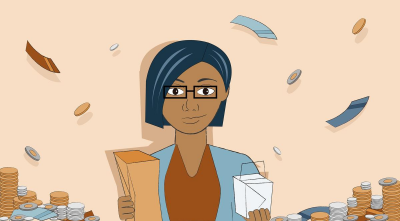 Feeling the pressure to put her savings somewhere, Susana wrote to Millennial Money hoping to get advice on what how to manage her finances and if buying a house in the city should be her main goal.
Growing your wealth
– moneysense.ca
 Photo by Andre Furtado from Pexels
During Sobia Ali’s first few years in Canada, she found it almost impossible to save money. She first moved to Toronto from Pakistan in 1997, after marrying her Pakistani fiancé, who had already moved to Canada. Despite having teaching experience and a degree in math and statistics from the University of Karachi, Ali was unable to find a job.
Eventually, she found a gig with a temp agency making $10 an hour, but most of her salary went to pay for daycare for her three-year-old daughter, Abir. Undeterred, Ali, now 43, set up a savings plan at her bank that automatically funneled $100 a month into her savings account. “It worked,” says Ali. “At the end of the first year, I had $1,200, and I started investing. I kept saving, and I used some of the money to buy a house last year.”
What are your goals?
After the rush of your first few years in Canada is over, and you’ve got your career on track, it’s time to focus on saving money and investing for the future…

