
Canada has several major banks and many schedule II banks – but with rates and plans all over the map, it’s difficult to know where to bring your business. Our aim is to help you navigate Canada’s banking options to discover which one suits your needs best.
Latest News



How Do Travel Rewards Work on a Credit Card? Jan 11th
So, you want to take a dream vacation. Is it worth it to rack up charges on your travel rewards credit card? This can be an excellent way for you to save money, but only if you can maintain a reasonable level of spending and pay off your debt in full each month. If you stay on top of your spending .... More »
How To Get The Best Home Insurance Quote in Canada Nov 27th
Unlike car insurance, in Canada, there is no legal requirement to have homeowners insurance. But that doesn’t mean you should go without it. Find out why you need insurance and how to get the best homeowners insurance quotes in Canada.
Why Do Homeowners Need Insurance in Canada?
Although not legal.... More »
Making sense of the markets this week: September 6, 2021 Sep 4th
Each week, Cut the Crap Investing founder Dale Roberts shares financial headlines and offers context for Canadian investors.
The rich get richer as rates go lower
We know that lower rates set by central banks help to stimulate economic growth by providing cheap money. On the flipsi.... More »
Canada’s best credit cards for gas Dec 6th
Gas costs can be a hefty line item, especially for Canadians with a daily commute or even a hybrid situation—and it’s one that is largely out of our individual control. Using the right credit card when you fill up will earn you a return on your fuel expenses. But which card should you pick? We b.... More »
Interest rates: From lower for longer, to low for no longer + MORE Jun 14th
Carolyn Wilkins. (Photograph by Erin Schaff)
Inflation is coming.
Ha-ha! You don’t believe me, do you? I can hardly blame you. Economists used to talk about prices as if they were barely domesticated animals: loosen the tether, and they will will take off on you. Those economists now look like fo.... More »
Drive to hit sales goals sees bank employees put customer's finances at risk committee hears
– cbc.ca
Longtime bank employees blew the whistle on questionable practices by Canada’s big banks during a House of Commons committee hearing Wednesday.
Home equity lines of credit push Canadians into debt
– moneysense.ca
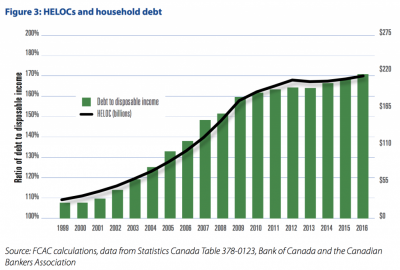 It’s not just skyrocketing real estate prices that have regulators worried. It’s also the fact consumers have been tapping the swelling equity in their homes and don’t seem to be in a hurry to pay it back. In fact, many are only covering the interest payments, which are at near-record low rates. The Financial Consumer Agency of Canada is out to raise awareness of this problem, with a warning that carrying more debt for longer could “put stress on Canadian households, at a time when they are carrying record amounts of debt.”
Essential bank jargon: Two terms the FCAC wants you to wrap your head around are “HELOCs” (home equity lines of credit) and “readvanceable mortgages” (an unfortunate mouthful that refers to term mortgages wrapped up with HELOCs and sometimes other products such as credit cards). Canadians are bingeing on HELOCs, with much encouragement from the banks, and the FCAC says readvanceable mortgages have become the default mortgage choice for anyone who has put down 20%…
What is Canada’s infrastructure bank for?
– macleans.ca
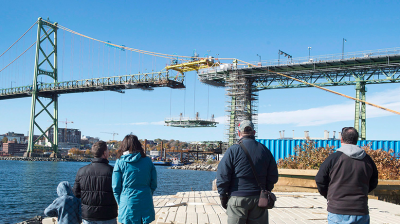 Spectators watch as workers place a new section of the deck for the Angus L. Macdonald Bridge spanning the harbour in Halifax on Saturday, October 31, 2015. The project is called The Big Lift and involves replacement of the suspended spans of the structure. Commuters have faced nightly and weekend closures and delays travelling between Halifax and Dartmouth. (Andrew Vaughan/CP)
If your banker asked for $1,000, you would probably reply: “what for?”
The Liberal government is asking taxpayers for $35 billion—which roughly equals $1,000 per Canadian—to start a new “infrastructure bank.”
So it’s fair for us to ask: “what for?” Let us go through the possible reasons until we find the real one.
The most obvious reason is to fund infrastructure. But there is nothing preventing private sector banks, capital markets, pension funds, and private equity enterprises from investing in infrastructure. In fact, they already bankroll trillions of dollars of construction projects—to the tune of $2 trillion worldwide, according to estimates in the government’s Fall Economic Update…

