
The “Big Five” Canadian banks offer credit cards and include Royal Bank of Canada, Toronto Dominion Bank (TD Canada Trust), Bank of Nova Scotia, Bank of Montreal and Canadian Imperial Bank of Commerce (CIBC). Did you know that there are many other options?
Latest News



Rewards Canada Clash of the Reward Charts! Amex Fixed Points for Travel versus RBC Avion Air Travel Redemption + MORE Dec 1st
Welcome to next Rewards Canada Clash! If you listened to our podcast from June entitled Clash of the Credit Cards - you'll know that we've changed our Showdown features to Clashes. The reason why is that lots of sites and blogs are using Showdown now, some are using battle so we wanted t.... More »
Reminder - Only three weeks left to earn those American Express Shop Small statement credits + MORE Aug 21st
Back in June American Express Canada launched the best ever version yet of their Shop Small campaign and this is just a reminder to all of our readers that you have a little over two three weeks left to earn those credits for shopping at those small and independent Canadian merchants!The.... More »
RWRDS Daily Update – June 5, 2024: Earn 100 bonus miles via AIR MILES Shops and eBay to stop accepting American Express + MORE Jun 5th
Earn 100 bonus miles shopping online via AIR MILES Shops and eBay to stop accepting American Express Cards as of August 2024. Check out today's points & miles updates here:
The post RWRDS Daily Update – June 5, 2024: Earn 100 bonus miles via AIR MILES Shops and eBay to stop accepting American.... More »
Folks, pay more than the credit card minimum + MORE Feb 23rd
This week, new research from TransUnion found that Canadian consumers who make more than the minimum payments monthly on their credit card debt are also more likely to make higher payments on other types of credit as well. The research, which looked at consumers in Canada, Hong Kong and the United S.... More »
Turning to credit to fund pricey addiction rehab + MORE Oct 19th
As a last resort, your credit cards can provide a lifeline to recovery.... More »
Banks, credit card firms reach deal with Ottawa over fees: sources
– theglobeandmail.com
Voluntary agreement includes cutting rates charged to merchants, capping fees
OTTAWA – Canada’s major banks and credit card companies have reached a deal with the federal government to cut the fees charged to merchants for credit transactions, sources familiar with the negotiations say.
The voluntary agreement could mean cost savings for up to 700,000 large, medium-sized and small businesses across the country.
However, it remains to be seen whether the cuts will translate into savings for consumers.
The deal will result in lower interchange fees charged to retailers and service providers for using credit cards to complete direct transactions, said sources speaking on condition of anonymity because they weren’t authorized to discuss the matter publicly.
The fees would then be capped for an unspecified period of time.
The agreement comes after years of back-and-forth among retailers, the federal government, banks, credit card companies and the Competition Tribunal.
Interchange fees currently range between $1.50 and $3 or more for every $100 worth of transactions, depending on the credit card…
The voluntary agreement could mean cost savings for up to 700,000 large, medium-sized and small businesses across the country.
However, it remains to be seen whether the cuts will translate into savings for consumers.
The deal will result in lower interchange fees charged to retailers and service providers for using credit cards to complete direct transactions, said sources speaking on condition of anonymity because they weren’t authorized to discuss the matter publicly.
The fees would then be capped for an unspecified period of time.
The agreement comes after years of back-and-forth among retailers, the federal government, banks, credit card companies and the Competition Tribunal.
Interchange fees currently range between $1.50 and $3 or more for every $100 worth of transactions, depending on the credit card…
Banks, credit card companies cutting rates charged to merchants, capping fees
– canadianbusiness.com
OTTAWA – Canada’s major banks and credit card companies have reached a deal with the federal government to cut the fees charged to merchants for credit transactions, sources familiar with the negotiations say.
The voluntary agreement could mean cost savings for up to 700,000 large, medium-sized and small businesses across the country.
However, it remains to be seen whether the cuts will translate into savings for consumers.
The deal will result in lower interchange fees charged to retailers and service providers for using credit cards to complete direct transactions, said sources speaking on condition of anonymity because they weren’t authorized to discuss the matter publicly.
The fees would then be capped for an unspecified period of time.
The agreement comes after years of back-and-forth among retailers, the federal government, banks, credit card companies and the Competition Tribunal.
Interchange fees currently range between $1.50 and $3 or more for every $100 worth of transactions, depending on the credit card…
The voluntary agreement could mean cost savings for up to 700,000 large, medium-sized and small businesses across the country.
However, it remains to be seen whether the cuts will translate into savings for consumers.
The deal will result in lower interchange fees charged to retailers and service providers for using credit cards to complete direct transactions, said sources speaking on condition of anonymity because they weren’t authorized to discuss the matter publicly.
The fees would then be capped for an unspecified period of time.
The agreement comes after years of back-and-forth among retailers, the federal government, banks, credit card companies and the Competition Tribunal.
Interchange fees currently range between $1.50 and $3 or more for every $100 worth of transactions, depending on the credit card…
Who will benefit the most from income splitting?
– moneysense.ca
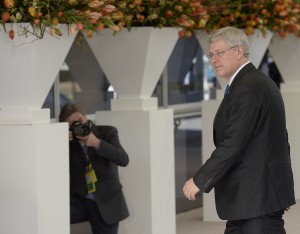 (MARCO DE SWART/AFP/Getty Images)
The federal Conservatives moved on a four-year-old election promise Thursday by introducing income splitting for families, dubbing it “The Family Tax Cut.” The government also rolled out a surprise enhancement of the Universal Child Care Benefit and a $1,000 increase in the maximum amount that can be claimed under the Child Care Expense Deduction.
As expected, the plan unveiled by Prime Minister Stephen Harper and Finance Minister Joe Oliver in Vaughan, Ont., allows families with children under the age of 18 to transfer as much as $50,000 worth of income from the higher-earning spouse to the lower-earning spouse for tax purposes starting in this year.
The wrinkle is that the resulting non-refundable tax credit has been capped at $2,000 per couple.
This means income splitting will provide a meaningful saving opportunity for Canadian families, but not as much as previously thought.
The maximum credit of $2,000 per couple was added after fierce criticism from pundits that income splitting would benefit higher-income families more so than lower-income families…
OTTAWA – Canada’s major banks and credit card companies have reached a deal with the federal government to cut the fees charged to merchants for credit transactions, sources familiar with the negotiations say.
The voluntary agreement could mean cost savings for up to 700,000 large, medium-sized and small businesses across the country.
However, it remains to be seen whether the cuts will translate into savings for consumers.
The deal will result in lower interchange fees charged to retailers and service providers for using credit cards to complete direct transactions, said sources speaking on condition of anonymity because they weren’t authorized to discuss the matter publicly.
The fees would then be capped for an unspecified period of time.
The agreement comes after years of back-and-forth among retailers, the federal government, banks, credit card companies and the Competition Tribunal.
Interchange fees currently range between $1.50 and $3 or more for every $100 worth of transactions, depending on the credit card…
The voluntary agreement could mean cost savings for up to 700,000 large, medium-sized and small businesses across the country.
However, it remains to be seen whether the cuts will translate into savings for consumers.
The deal will result in lower interchange fees charged to retailers and service providers for using credit cards to complete direct transactions, said sources speaking on condition of anonymity because they weren’t authorized to discuss the matter publicly.
The fees would then be capped for an unspecified period of time.
The agreement comes after years of back-and-forth among retailers, the federal government, banks, credit card companies and the Competition Tribunal.
Interchange fees currently range between $1.50 and $3 or more for every $100 worth of transactions, depending on the credit card…

