
How to go about securing the best return for your investment in Canada.
Latest News


How to choose a financial advisor in Canada + MORE Apr 18th
Do you know what to look for when choosing a financial advisor? This person will be giving you advice on important things like insurance, money management and investing, so it’s worth taking the time to screen candidates carefully before you hire a financial advisor.
The terms “financial advi.... More »
Trudeau announces two-way investment deal with India worth $1-billion + MORE Feb 20th
The news came after Prime Minister Justin Trudeau spent his third morning in India meeting with six of this country’s most influential business tycoons
.... More »
The best GIC rates in Canada for 2024 + MORE Dec 30th
GIC comparison tool
Find the best and most up-to-date GIC rates in Canada using the comparison tool below. Plus, use the filters to assess your estimated rate of return based on the size of your balance.
Why trust us
MoneySense is an award-winning magazine, helping Canadians navigat.... More »
How has inflation affected Canadians’ finances in recent years? Oct 10th
Inflation and higher interest rates have eroded Canadians’ purchasing power since 2022, particularly for lower-income households, a new report from the parliamentary budget officer has found.
But wealthier households have seen their purchasing power rise thanks in big part to their i.... More »
Buying ETFs in Canada Tool: The MoneySense ETF Screener + MORE Nov 10th
If you’re researching ETFs to buy, you’ve come to the right place. Below you will see the tables for different ETF categories, offering ETF options from some of the best ETF providers in Canada. We’ve included some helpful ETF asset class, geography, provider, tickers, as well as one-year retu.... More »
How to find stocks that are financially solid
– moneysense.ca
 A strong balance sheet helps good stocks measure up. (Flickr)
What are we looking for?
Canadian stocks that show strong balance sheet characteristics
The screen
If you were given the offer to buy out a company, you likely wouldn’t accept without first doing research – or at least hopefully not. You’d probably want to understand more about the business, any potential competitors, and perhaps most importantly, understand the company’s financial strength. One of the best places to look to evaluate a company’s financial strength is their balance sheet. Being able to understand what the company has going for them as well as any obligations they have against them will give you a much clearer numerical picture as to whether or not this company would make a good purchase.
Picking a successful portfolio of stocks requires that same level of discipline, just on a larger scale. Through whatever research tools you have available at your disposal, you need to understand whether the companies you invest in are in good financial shape and decide if they are a worthwhile investment…
Market has you on edge? Sit tight with the ‘CATS’
– moneysense.ca
 (Flickr)
The markets caught a bout of volatility in the last two weeks. A sudden downdraft led to breathless headlines of impending doom followed by a bounce back.
Overall, stocks have been on a long bull run since the U.S. market bottomed in 2009. But the aging bull market comes with lofty valuations that were rarely seen in the past. It’s enough to inspire a case of the willies.
Every seasoned investor knows that, just as night follows day, stocks will eventually stumble. Market corrections are relatively common and occur when the market falls more than 10% from its prior peak. Bear markets are a little less common but are likely to occur many times in an investor’s lifetime. They are marked by declines of more than 20%. Even larger market downturns, say of the 50% variety, are fairly rare but they happen.
Despite the poor periods, the stock market has been good to investors who slowly bought in during their working years and then slowly sold in retirement. A sudden market surge, or collapse, in any given day, month, or year shouldn’t change the overall picture much…
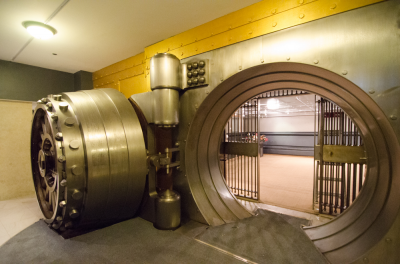
How safe are my retirement savings if the bank fails
– moneysense.ca
 (Flickr)
I am considering retiring early (at 55) and based on advice from my financial planner, I can rather easily do so, primarily based on our assets, lack of any debt, and my wife’s existing defined benefit pension plan.
He suggests converting my pension and RRSP holdings into a RRIF. My concern with that is should something happen to the company, can the value of a RRIF be protected or insured? Is there any way of structuring a RRIF to allow for better protection?
I don’t want to see my life long savings disappear overnight.
– Roland
Congratulations on your potential early retirement, Roland. There are a few considerations as it relates to the stability of your retirement savings.
First off, whether your retirement savings are in an Registered Retirement Savings Plan (RRSP) or a Registered Retirement Income Fund (RRIF) likely won’t make a difference. The decision to convert your RRSP to a RRIF is more of an administrative one if your plan is to withdraw from the account every year going forward…
Remember when fund managers were rock stars?
– moneysense.ca
 (Flickr(
(Excerpted from The Professional Financial Advisor IV by John De Goey)
In the 1990s … it seemed everyone had a take on how to identify top-performing mutual funds. At the time, it seemed no one could get enough information about what mutual funds were, how they worked, and how to build portfolios using them. Annual fund-ranking books were presumably helpful in allowing consumers to make smart investment decisions. No one publishes books that rank funds anymore. Why not? Furthermore, why did most books disagree on what the best funds actually were?
If the research was indeed empirical and predictive, shouldn’t they all have identified the same funds? And if the books were so committed to a long-term perspective, why did so many of the recommended funds change from one year to the next—even from the same authors?
Those authors weren’t selling timeless and useful information at all; they were simply selling books. And books that need to be updated annually have the handy attribute of built-in obsolescence, meaning they could be tweaked, repackaged, and sold anew twelve months later…
 (Flickr)
Q. I’m a 60-year-old retired school teacher as of this past July 2017. I have $44,000 in unused RRSP contribution room. Should I max out my contribution room on my 2017 taxes? Or just stick to topping up my TFSA? Thanks, Chris
Hi Chris. Thanks for the question. Please note that RRSP only counts as a deduction against “earned income” which includes:
Net income from employment, business or a partnership;
Net rental income from real estate;
Disability pensions (issued under CPP or QPP); and
Spousal support payments included in your income.
If your income is not from one of these sources it is likely not considered “earned income” meaning your RRSP contribution will not be a deduction. If you do have earned income then let’s note a few things:
The primary goal of using an RRSP is to defer current income to be able to draw that income later in a lower tax bracket.
Income drawn from an RRSP is fully taxable.
Should you pass on, your RRSP will be fully taxed prior to being paid to your estate…

