
Obtaining a mortgage or secured line of credit in Canada at the best rates is often a daunting task. We can help! Read the articles below for more info.
Latest News

Top Performers: Kelli Pardo + MORE Jun 17th
By Vanessa Chris, Special to CMT Some believe there are countless attributes that define a top performer in the mortgage industry, but for Kelli Pardo, only a few really matter. The key success ingredient for this Alberta-based Invis agent is establishing an airtight bond with clients, lender .... More »
How new mortgage brokers are overcoming the challenges of today’s high-rate environment Jan 24th
It's no secret that the current high-rate environment has been challenging for mortgage borrowers and mortgage professionals alike..... More »
Cost of Mortgage is Going Up: CMHC Hikes Mortgage Insurance Premiums + MORE Mar 22nd
Note: Mortgage insurance premium increases go into effect on March 17th, 2017.
If you’re applying for a mortgage with a small down payment, be prepared to pay a little more every month for default insurance.
The Canadian Mortgage and Housing Corporation recently announced it will increase the pre.... More »
How the mortgage stress test is impacting qualification amounts + MORE Jun 22nd
As of June 2022, we are currently seeing unnatural discrepancies in the size of mortgage loans borrowers will qualify for, and it’s all because of a rift in the space-time stress test continuum. You see, most 5-year fixed mortgage rates are already over 5%, making their stress test a full 2% highe.... More »
The Parliamentary Budget Office Reminds Us that Higher Interest Rates Would Bring Challenges Jun 23rd
When Interest Rates Inevitably Rise… In a new report on “household indebtedness and financial vulnerability,” the Parliamentary Budget Office (“PBO”) has provided calculations on how increased interest rates would affect debt service costs for Canadian consumers. The PBO report assumes tha.... More »
How much does a 1996 house cost today?
– moneysense.ca
Housing prices are much higher today, but interest rates are significantly lower. So, has housing affordability actually changed? To appreciate the impact of inflation let’s take a look at, as an example, the cost of homes today versus 10 or 2o years ago in Toronto.
According to the Toronto Real Estate Board’s historic home prices for Toronto, houses cost, on average:
According to the Toronto Real Estate Board’s historic home prices for Toronto, houses cost, on average:
Year
Average Price
Average 5-year mortgage rate
20% down payment required
2016
$739,382*
2.33%
$147,876
2006
$351,941
5.25%
$70,388
1996
$198,150
9%**
$39,630
*Based on April 2016 data
**Based on BoC prime + 2%
But to really compare these costs, let’s factor out inflation. Using the Bank of Canada’s inflation calculator, here’s what homes and mortgage payments would look like in today’s dollars:
Year
Average Price
In today’s $
20% down in today’s $s
% change in those years
2016
$739,382*
$739,382
$147,876
0%
2006
$351,941
$413,498
$82,670
17.49%
1996
$198,150
$286,614
$57,232
44…
Being hooked on debt has long-term consequences
– moneysense.ca
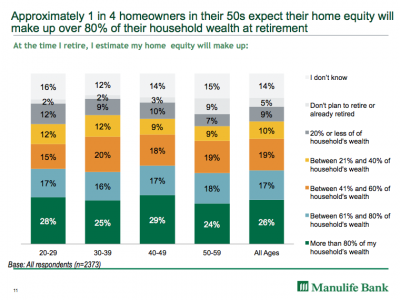 Hooked on debt. It’s an apt description for the rising debt-to-income levels currently seen in Canada and a new survey by Manulife Bank highlights there’s a high price to our debt dependency—a cost that goes far beyond the low interest rates you see posted online.
Impact on those approaching retirement
One of the biggest contributors to our increased debt-load are rising housing costs. These increased shelter costs make it far more difficult for homeowners to balance paying down their mortgage, while saving for retirement and managing day-to-day expenses, explains Rick Lunny, president and CEO of Manulife Bank of Canada.
According to the new Manulife Bank Canada survey, 37% of homeowners were “caught short” at least once in the past year—meaning they didn’t have enough money to cover their expenses. Worse, only 40% of Canadians are confident that they are saving enough for retirement. “For many, not saving enough means relying on their home equity as a significant portion of their retirement package,” says Lunny…
A rising housing market lifts builders, home goods retailers
– canadianbusiness.com
NEW YORK, N.Y. – A new report from the U.S. that showed Americans are snapping up homes at a pace not seen since the housing bust-fueled recession pushed the trading of shares of all companies affiliated with the sector into overdrive Tuesday.
The Commerce Department reported that new home sales jumped 16.6 per cent last month to a seasonally adjusted rate of 619,000, up from a revised total of 531,000 in March. A mix of steady job gains and historically low mortgage rates are bringing more Americans back into a housing market even as rising prices put many properties out of range.
Sales of existing homes, which make up 90 per cent of the housing market, rose in April for a second straight month to an annual pace of 5.45 million, a figure consistent with a solid economy.
That’s the highest level since January 2008, when the U.S. was teetering into the worst economic downturn since the Great Depression.
While there has been talk about the possibility of a second housing bubble bursting as it began to do in the U…
The Commerce Department reported that new home sales jumped 16.6 per cent last month to a seasonally adjusted rate of 619,000, up from a revised total of 531,000 in March. A mix of steady job gains and historically low mortgage rates are bringing more Americans back into a housing market even as rising prices put many properties out of range.
Sales of existing homes, which make up 90 per cent of the housing market, rose in April for a second straight month to an annual pace of 5.45 million, a figure consistent with a solid economy.
That’s the highest level since January 2008, when the U.S. was teetering into the worst economic downturn since the Great Depression.
While there has been talk about the possibility of a second housing bubble bursting as it began to do in the U…
What to do with your extra cash
– moneysense.ca
 (Getty Images)
Q: I am turning 30 this year and make around $60,000 a year and was wondering what the best thing to do with some extra money is? I have $10,000 saved in an emergency fund sitting in a high-interest bank account at my bank, so I am covered in case of emergency. Is this the best place for this?
On top of that I have around $5,000-$10,000 extra I am looking to use to start investing and was wondering where it should be put. I have no debt other than a mortgage for $90,000 with 10 years left at 3% which I am already paying an extra 10% per payment towards. I have an RRSP through my work, but I am only contributing 3% in order to max out their matching 3%. I am doing the minimum because it has a high MER of about 2.75%.
I was thinking of starting a Couch Potato Portfolio via a robo-advisor site or inside of a TFSA as I have never contributed to a TFSA. I have never done any investing other than RRSPs through my jobs so I could use some advice to ensure I am using my money wisely…

