

1.4 million Canadians missed a credit payment in second quarter + MORE Aug 20th
The latest in mortgage news: National Bank among first to offer First Home Savings Account Apr 19th

Deferred payments on your mortgage or credit card? How to handle the strain when payments restart this fall + MORE Jul 28th

For many homeowners 55+, the goal is no longer downsizing, but aging in place + MORE Jul 23rd
Optimism Returns to the Markets. Could Fixed Rates Start to Rise? Nov 13th
 TORONTO — An emergency fund is meant to be there in times of need, but a new survey suggests nearly half of Canadian homeowners would be ill prepared for a personal financial dilemma such as job loss.
The poll released today by Manulife Bank finds that 24 per cent of those surveyed don’t know how much is in their emergency fund, 14 per cent have not put away any funds and nine per cent have access to $1,000 or less.
The remainder of those surveyed have up to $10,000 saved, with the average amount being $5,000.
Forty-six per cent of Canadian homeowner households say they would have difficulty making mortgage payments within six months of the primary earner losing their job, a survey from Manulife Bank has found. (Photo: Roy Hsu/Getty Images)
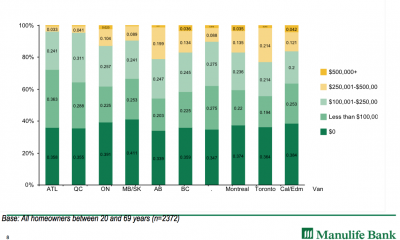
Manulife says among those polled, homeowners had an average of $174,000 in mortgage debt, with an average of 28 per cent of their net income going toward paying off their home each month.
About half (46 per cent) of those polled say they would have difficulty making their monthly mortgage payments in less than six months if their household’s primary income earner lost his or her job…
Smart Moves: Getting a pre-approved mortgage
– canada.com
Tame the debt monster
– moneysense.ca
brightcove.createExperiences();
Would $1,000 in the bank cover all your bills for the next six months? Probably not. And yet, about a quarter of Canadian homeowners confess to only having $1,000, or less, set aside for an emergency.
These are the findings of the latest survey by Manulife Bank of Canada. Turns out, more than a third of mortgage holders in Canada would have difficulty making their regular mortgage payment within three months if the main income earner in their household lost their job. Yet, experts, including Manulife Bank, recommend that each household keeps enough in emergency savings to cover three to six months of expenses.
“A high-interest savings account is a good option. Or, if you’ve got a home equity line of credit, you could use your savings to reduce your debt and save interest – and still have access to that money if an emergency arises,” said Rick Lunny, president and CEO of Manulife Bank of Canada…
How much more you need to afford a home now
– moneysense.ca
 We all know that last month the federal Liberals made changes to mortgage rules across Canada, mainly requiring a stress test for borrowers of the common five-year fixed rate mortgage. Borrowers are now required to qualify for loans at the Bank of Canada’s posted rate (about two percentage points higher than current offered rates). Sure, we’ve heard the numbers, but it’s difficult for the average home buyer to fully know what all this means for purchasing power and their bottom line.
Well, now we know. Mortgage rate site Ratehub.ca has crunched the numbers for several cities across Canada and what they found was consistent throughout—it’s going to take a much larger household income to buy a home than just a year ago.
In fact, they found that to get an insured mortgage on an average-priced house, you will need at least 20% more income than you did before the rules came into place last month.
For instance, in Toronto, you’ll need nearly 25% more income (an extra $29,000 or so) than before to afford an average house…

