
There are plenty of retirement plan options in Canada! Stay on top of the best plans right here.
Latest News


Close to retirement? Don’t panic, say financial experts Mar 23rd
If you are going to dip into your savings, do so in a planned way and track what you remove..... More »
How much real estate should you have in a balanced portfolio? May 11th
When investors talk about income-producing assets, the first that come to mind are dividends and interest, with capital gains a close third. But what about investment real estate? If you hold an asset allocation ETF, it will be chock full of stocks and bonds but offer little real estate exposure apa.... More »
Is it best to own a first home as an income property or primary residence? + MORE Jun 1st
Q. I would like to know whether it is better, financially speaking, to own my first house as an income property, or as my primary residence in Ontario. I am single, living with my parents, earn a steady income and have $80,000 in savings. I’ve already purchased a new-construction freehold townho.... More »
30 and no pension: What are your options? Sep 6th
Alexandre Crupi has a lot of expenses. The 31-year-old investment specialist at Steadyhand Investment Funds, along with his fiancee, are paying for a September wedding. Then there’s the cost of their forthcoming honeymoon. They hope some day to buy a house. On top of all that, Crupi doesn’t curr.... More »
CPP payment dates this year, and more to know about the Canada Pension Plan + MORE Aug 30th
In Canada, no retirement plan is complete without considering the CPP. Whether you’re approaching retirement or still several years away from it, the Canada Pension Plan will likely play a role in your retirement income. How big a role depends on several factors. You may have other questions, too..... More »
Why you should top up your TFSA
– moneysense.ca
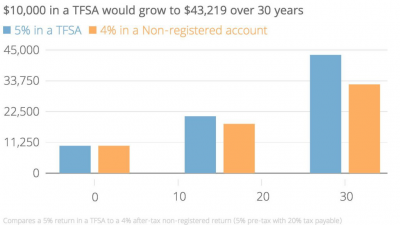 It’s not uncommon for people with unused space in their tax-free savings account or RRSP room to hold non-registered investments simultaneously. While you could make a case for not maxing out your RRSP, it’s tough to justify leaving room in your TFSA if you have the savings available. (One exception might be if you have non-registered investments with accrued capital gains that will trigger a large tax liability if you sell or transfer the investments.) Here’s what could happen if you move your non-registered savings into a TFSA and limit the amount of taxable income you’re earning.
Want even more tips to shape up your finances? Join the Money Fit Club to curb spending, boost your earnings, lower your taxes and more!
Learn to tone your money muscles all year long with our interactive calendar and sign up for our weekly newsletter for advice straight to your inbox.
The post Why you should top up your TFSA appeared first on MoneySense.
Withdrawing money from a spousal RRSP
– moneysense.ca
Q: If I have two spousal RRSPs, can I stop contributing to RRSP No. 1 for three years and then begin to withdraw from it without being subject to attribution rules, even if during that time I contribute to RRSP No. 2?
—Murray Hooper, Cambridge, Ont.
A: “All for one. And one for all,” goes the mantra of the Three Musketeers. I think the Canada Revenue Agency is chanting that refrain when it comes to spousal RRSPs. “The CRA considers all spousal RRSPs as one, and all withdrawals from them subject to the standard attribution rules,” explains Cindy Brannan, an advisor with Toronto’s Brannan Investments. Spousal RRSPs allow couples to shift some savings from the bigger breadwinner to the smaller one, so that retirement income is taxed at a lower rate. The attribution rule basically says that your contribution must stay in the spousal RRSP for three years and prevents the spouse from immediately withdrawing that money, to avoid being taxed at the higher-income earner’s tax rate…
—Murray Hooper, Cambridge, Ont.
A: “All for one. And one for all,” goes the mantra of the Three Musketeers. I think the Canada Revenue Agency is chanting that refrain when it comes to spousal RRSPs. “The CRA considers all spousal RRSPs as one, and all withdrawals from them subject to the standard attribution rules,” explains Cindy Brannan, an advisor with Toronto’s Brannan Investments. Spousal RRSPs allow couples to shift some savings from the bigger breadwinner to the smaller one, so that retirement income is taxed at a lower rate. The attribution rule basically says that your contribution must stay in the spousal RRSP for three years and prevents the spouse from immediately withdrawing that money, to avoid being taxed at the higher-income earner’s tax rate…

