
How to go about securing the best savings strategy in Canada.
Latest News


Stock news: Cogeco, Roots, and BlackBerry deliver earnings gains but outlooks remain mixed + MORE Apr 15th
Here’s a round-up of news for Canadian investors this week.
Cogeco
Roots
BlackBerry
Featured RRSP Accounts
featured
EQ Bank
Build your retirement savings with 1.50% interest, t.... More »
Canada’s best credit cards 2021 + MORE May 8th
Finding the right credit card could save you hundreds, if not thousands, of dollars a year. Whether you’re looking for lower fees, more rewards or simply valuable perks like travel medical insurance or rental car savings, every dollar counts. If you use your credit card wisely, pay off your balanc.... More »
News for investors: Barrick settles Mali dispute and Couche-Tard profit climbs + MORE Dec 3rd
Here’s a round-up of news for Canadian investors this week.
Barrick Mining
Alimentation Couche-Tard
Blue Ant Media
Brookfield
Featured RRSP Accounts
featured
EQ Bank
Build y.... More »
Failing to Plan is Planning to Fail: Do You Have an Emergency Savings Fund? Jan 11th
If 2019 is the year you promised to stop your bad spending habits in their tracks and ensure your savings go untouched, then maybe the old proverb “failing to plan is planning to fail” hits home for you. But what about the things that don’t make it into the plan? You know, those expenses tha.... More »
26 ways the 2018 Ontario Budget affects your wallet + MORE Mar 29th
If there’s any way to describe the 2018 Ontario budget, it’s the word “free”. From free preschool daycare to free university tuition, to free drugs for those age 65 and over, there’s freebies for everyone—and lots of tax credits too.
Low-income earners and social assistance recipients
.... More »
Making smarter asset location decisions
– moneysense.ca
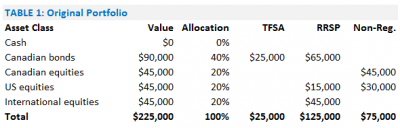 Last week’s posts about tax loss selling prompted some interesting questions about asset location in the comments section. Holding your ETFs and index funds in the most tax-efficient accounts can have a big impact on your long-term returns. But although it’s often easy to set up a portfolio with proper asset location, it can be a challenge to maintain the right balance when you add new money.
Say you’re using the Global Couch Potato portfolio spread across three accounts. Your TFSA and RRSP are maxed out at $25,000 and $125,000, respectively, and you have another $75,000 in a non-registered account. Your optimal asset location would look like this:
So far, so good. But now you’ve won second prize in a beauty contest and received a $25,000 windfall. Since you can’t add it to your tax-sheltered savings, you put the money in your non-registered account. Then you enter the new values into your rebalancing spreadsheet and discover your portfolio is now off its target:
The naive way to rebalance your portfolio would be to make all the transactions in your non-registered account…
Your Overspending Intervention
– ratesupermarket.ca

Paycheques are elusive things – it seems they’re gone as soon as they’re earned! We know mortgage payments, savings and financial planning can snap up your funds in a flash – but how good are you with your spending money?
If you find yourself tapping into money set aside for your needs to pay for shiny wants, you could be setting yourself up for a debt spiral. Here’s how to break that cycle.
3 Ways To Stop Spending On What You Don’t Need
How much is the status quo worth to you? Overspenders can come in all shapes and sizes – and with differing opinions when it comes to smart buys. If you’re constantly left wondering where your take home pay has gone, you could be making money mistakes without even realizing it.
Here’s how to target those daily spending sins and nip them in the bud.
Read Allan’s Blog | 3 Ways To Stop Spending On What You Don’t Need
Are You Impulse Buying Your Way Into Debt?
Do you know the difference between your wants and needs? According to a BMO Psychology of Spending report, many Canadians don’t, and it’s costing them $3,720 a year!
If you fall victim to retail spending traps, don’t worry – we have ways to help you break the cycle! Read on for our top tips to curb impulse purchases…
Beware of brokers urging you to take out loans: Roseman
– thestar.com
Borrowing to invest can be risky. An industry ombudsman called on two firms this week to repay clients who weren’t told they could lose money.
Financial Literacy Canada: Get Your Teen Involved
– ratesupermarket.ca

Canadians can be justifiably proud that, as a nation, we’re almost universally literate. But when it comes to “financial literacy”, too many of us would get a failing grade. It’s never too early to learn how to be smart with your money. So, to kick off Financial Literacy Month, here are some ways young Canadians can become more financially literate.
Financial Literacy Canada: It Starts With Family Planning
My kids are only five and eight years old, yet they both already have a pretty decent sense of the difference between wasting money and saving for something special. My older daughter, for example, recently knocked over a night table lamp and was quite concerned about how much it would cost to replace. And we used our summer vacation as a lesson in savings. We spent a week exploring the sights in New York City, but that meant we wouldn’t be able to go to Canada’s Wonderland.
Allow For Learning
One great way to help your kids learn some money smarts is to give them an allowance – provided that it’s tied to a specific set of chores…
A Balanced Federal Budget – But At What Cost?
– ratesupermarket.ca

Canadians can expect the government to balance the national budget by 2015 and provide a surplus, as deficit progress was announced to be $7 billion ahead of schedule last week.
While this indicates the government is taking steps to responsibly manage our nation’s spending and debt vulnerability, critics have called out their methods for achieving this balance. When it comes to creating a surplus, do the government’s ends justify the budget slashing means? It’s a question all Canadians should be asking.
Budget Surplus Or Bust
There’s been scrutiny that the Harper government is keen to balance the budget for political gain rather than economic progress. With the 2015 election approaching, the Conservatives are pushing to make good on the promises made during Harper’s 2011 campaign. These include introducing income splitting taxation for two-parent families (breadwinners would be able to share up to $50,000 with their unemployed or lower-paid spouse for tax claiming purposes), and upping the annual contribution limit for Tax Free Savings Accounts to $10,000…

