
How to go about securing the best policy for your insurance in Canada.
Latest News



Making sense of the markets this week: April 2, 2023 Apr 2nd
Kyle Prevost, editor of Million Dollar Journey and founder of the Canadian Financial Summit, shares financial headlines and offers context for Canadian investors.
Freeland fires again at Canadian Banks
There are several big-picture looks at the important aspects of the Canadian federal budget .... More »
What’s in Store for Global Bond Yields? Nov 3rd
Bond yields continue to suffer as interest rates around the world remain at near-record lows. According to a recent report by credit rating agency Fitch – which rates bonds and other credit held by government and corporations – “steep declines in global sovereign bond yields over the past f.... More »
How Small Businesses Can Stay Safe Against Cyberattacks + MORE Oct 19th
Today’s cyber thieves aren’t lone hackers working from their basements. Cybercrime increasingly has become full-fledged enterprises, complete with CFOs, HR teams and research and development budgets—and this “professionalization” of cybercrime presents a growing risk for small businesses, .... More »
What to do when you get laid off Oct 15th
At 7.1%, Canada’s unemployment rate is the highest it has been in four years and people in a variety of sectors have been feeling the pinch. A job loss is difficult for a lot of reasons. On top of the personal feeling of rejection, there can be many decisions to make involving legal, tax, insuranc.... More »
The best travel insurance credit cards in Canada for 2024 Jan 4th
Spend
The best travel insurance credit cards in Canada for 2024
Searching for the perfect credit card? In under 60 seconds, CardFinder narrows down your top matches without impacting your credit score, no SIN required.
Find my perfect card*
.... More »
Tontine: Retirement plan of the future?
– moneysense.ca
 (Andy Roberts/Getty Images)
Advances in life expectancy coupled with the decline of employer-sponsored defined benefit pension plans has greatly raised anxiety levels about seniors outliving their money.
Life annuities have long been touted as one possible remedy for prolonged longevity, which is why experts like finance professor Moshe Milevsky have dubbed them a form of “longevity insurance.”
But a more effective “retirement annuity” could be an almost-forgotten structure that originated in Europe in the 17th century. It’s called the tontine, a relatively unknown concept in modern times, although it has from time to time featured in various Hollywood movies (notably the novel and movie The Wrong Box).
A tontine is a seemingly morbid concept that involves the pooling of investments such that those who die end up subsidizing those who keep living. And Milevsky believes it’s time the financial industry or even governments stepped in to breathe new life into the concept.
The idea is presented in a just-published Cambridge University Press book entitled King William’s Tontine: Why the Retirement Annuity of the Future Should Resemble its Past…
Hybrids that pay you back
– moneysense.ca
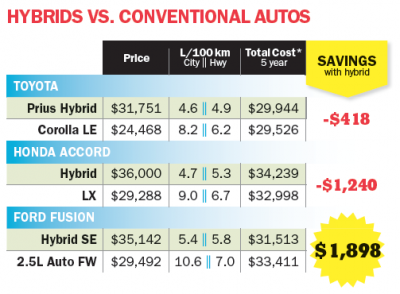 Hybrids help you cut down on trips to the gas station, but rarely actually save you money due to their higher sticker price. Below, we crunched the numbers to find out if any actually would save enough in gas purchases over five years to make up for the difference in cost between the hybrid and conventional versions of the same vehicles. What did we find out about hybrid fuel efficiency? The Ford Fusion Hybrid SE was the only car that came out ahead. The hybrid version provides you with nearly $1,900 of savings after five years, and would continue to save you money even if gas prices dropped as low as 82¢/L. Neither the Toyota Prius nor the Honda Accord Hybrid managed to break even at five years. Of those two, the Prius is more cost-efficient, but it wouldn’t make economic sense to buy unless gas prices topped $1.53/L.
Assumptions: 20,000 km driven/year; 60% city/40% highway; gas, $1.35 litre. Insurance costs based on 28-year-old with clean driving record. Depreciation costs assume 20% in 1st year and 10% in each subsequent year…

